

Picture a city where every neighborhood has its own power grid, its own water supply, and its own rules — yet all of them still trade with each other seamlessly. That’s the promise of modular blockchain architecture. Instead of forcing every application onto one congested highway, you build separate lanes, each tuned for a specific job. And honestly? For niche application chains, this isn’t just a nice idea anymore. It’s becoming the default playbook.
Let’s break down what that actually means, why it matters, and how builders are using it right now.
What “Modular” Really Means (Without the Jargon Overload)
A traditional blockchain — think early Ethereum or Bitcoin — is monolithic. It does everything in one place: execution, consensus, settlement, and data availability. That’s like a single restaurant where the same person cooks, serves, washes dishes, and handles the books. Impressive, sure. But it doesn’t scale well when 500 hungry customers walk in.
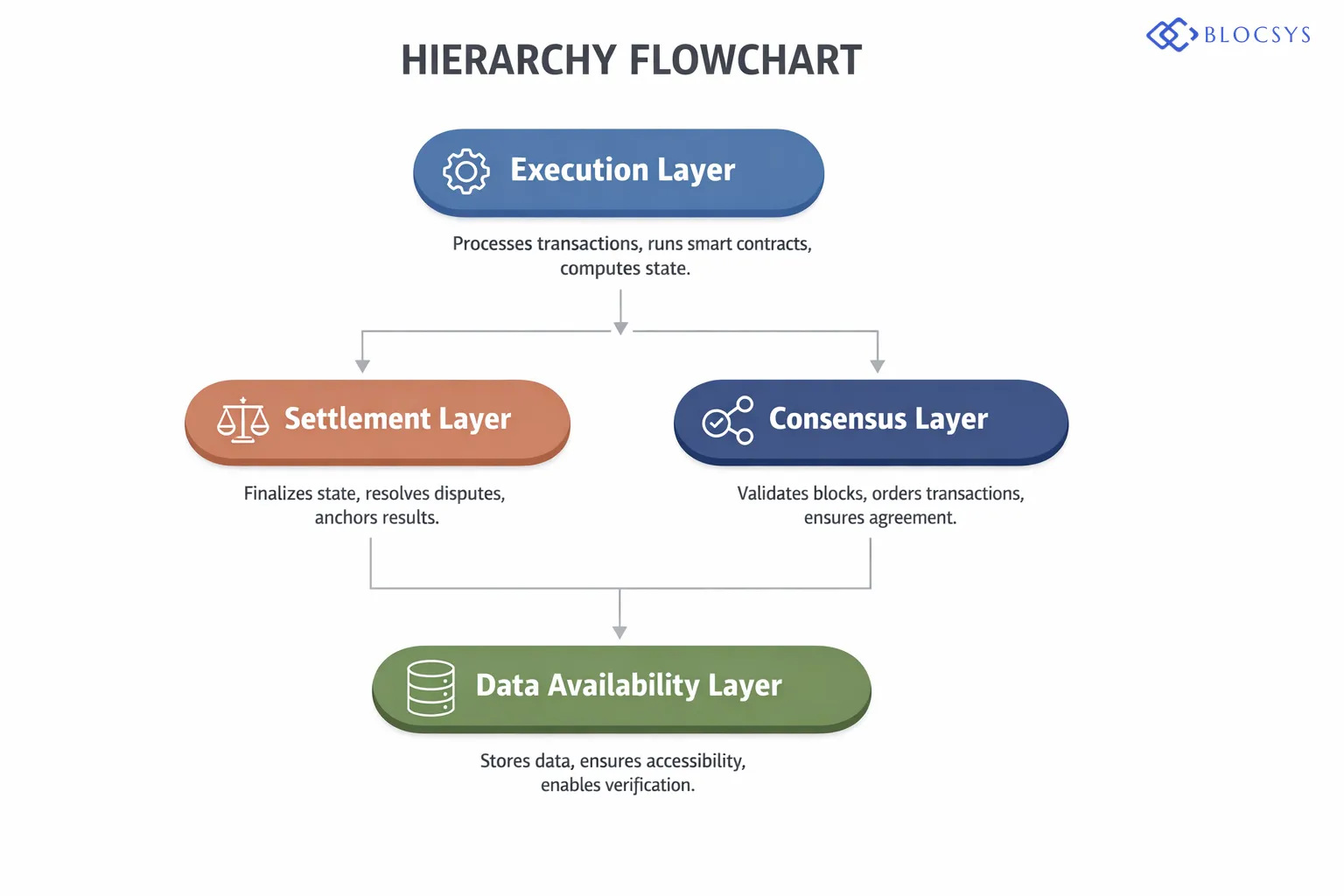
Modular architecture splits those jobs apart. Each layer specializes:
- Execution layer — where transactions actually run and smart contracts live.
- Settlement layer — where disputes get resolved and finality is anchored.
- Consensus layer — where nodes agree on what happened.
- Data availability layer — where proof that data exists is published, cheaply.
When you separate these, you can swap pieces in and out. Want faster execution? Plug in a different execution environment. Need cheaper data? Use a dedicated DA layer like Celestia or EigenDA. It’s Lego-like, and that flexibility is exactly what niche chains need.
Why Niche Application Chains Are Booming
Here’s the deal: general-purpose chains try to serve everyone. DeFi traders, gamers, supply chain folks, social apps — all fighting for the same block space. The result? High fees, slow finality, and a user experience that feels like dial-up in a fiber-optic world.
Niche application chains flip that. They serve one community, one use case, one set of needs. A gaming chain doesn’t care about MEV extraction the way a DEX does. A supply chain chain cares about timestamping and audit trails, not yield farming. When you build for a niche, you can optimize ruthlessly.
And modular architecture makes spinning up that niche chain… well, not trivial, but way more feasible than it used to be. You don’t need to bootstrap a whole validator set from scratch if you’re settling to Ethereum or using shared security. You don’t need to invent a consensus mechanism. You just assemble the modules you need.
The Building Blocks in Practice
Let’s get concrete. Say you’re building a chain for a decentralized music streaming app. Artists upload tracks, fans stream them, royalties get split automatically. What do you actually need?
| Layer | What You’d Use | Why |
|---|---|---|
| Execution | Rollup framework (OP Stack, Arbitrum Orbit, zkStack) | Custom gas tokens, app-specific precompiles |
| Settlement | Ethereum or a shared settlement hub | Security inheritance, dispute resolution |
| Data Availability | Celestia, EigenDA, or Avail | Cheap publishing of track metadata and proofs |
| Consensus | Borrowed from settlement layer or a sovereign set | No need to reinvent the wheel |
Notice something? You’re not building everything. You’re composing. That’s the whole point. And for niche chains, composition means faster time-to-market and lower overhead.
The Trade-Offs Nobody Talks About Enough
Sure, modular sounds great. But it’s not magic. There are real trade-offs, and pretending otherwise does nobody any favors.
- Complexity shifts, it doesn’t vanish. You now have more moving parts. Bridging between layers, managing upgrades across modules — it’s a different kind of headache.
- Liquidity fragmentation. A niche chain has its own users, but they’re not automatically connected to the broader ecosystem. You need bridges, and bridges have historically been… let’s say, a weak spot.
- Sequencer centralization. Many app chains start with a single sequencer. That’s a training wheel, not a permanent solution. But removing it takes time and careful planning.
That said, these are engineering problems, not dealbreakers. The ecosystem is maturing fast. Shared sequencers, decentralized prover networks, and standardized bridges are all in active development.
Real-World Examples Worth Studying
You don’t have to look far to see modular niche chains in the wild.
dYdX v4 moved to its own Cosmos-based chain for perpetual trading. Why? Because order book performance on a general chain was never going to cut it. They needed custom throughput and didn’t want to share block space with NFT mints.
Immutable zkEVM targets gaming specifically. Low fees, fast finality, and tooling that game developers actually understand. It settles to Ethereum but runs its own show.
Celestia’s rollup ecosystem is basically a laboratory for this stuff. Hundreds of teams are experimenting with app-specific rollups that use Celestia purely for data availability. Some will fail. Some will become the next big thing. That’s how it goes.
When Should You Actually Go Modular?
Not every project needs a dedicated chain. Honestly, most don’t. If you’re building a simple NFT marketplace or a token with basic staking, a general-purpose L2 will do just fine. Don’t over-engineer.
But consider modular niche architecture if:
- Your app has unique throughput or latency requirements (gaming, trading, real-time payments).
- You need custom gas economics or fee abstraction that a shared chain can’t offer.
- Your community wants sovereignty over upgrades and governance.
- You’re hitting walls with shared block space — either cost or congestion.
If two or more of those apply, it’s worth a serious look. If not, save yourself the complexity.
The Road Ahead (And a Few Honest Caveats)
Modular blockchain architecture isn’t a silver bullet. It’s a design philosophy — one that says specialization beats generalization when you know exactly who you’re serving. For niche application chains, that philosophy fits like a glove.
But here’s the thing… the tooling is still young. Documentation is scattered. Best practices are being written in real time by teams who are figuring it out as they go. If you’re an early adopter, expect some rough edges. Expect to debug things nobody has debugged before.
And yet, that’s also where the opportunity lives. The builders who master modular composition today will be the ones shipping the most compelling applications tomorrow. Not because they followed a trend, but because they chose the right architecture for the right problem.
The monolithic era gave us proof that decentralized systems could work. The modular era is about making them work well — for specific people, with specific needs, at scale.
That’s not hype. That’s just good engineering.